Vanilla has a deadline: this morning
A vanilla pod begins with an urgent hand movement and ends with months of careful work. The journey explains both the ingredient and the people too easily left out of its story.
The job that cannot wait
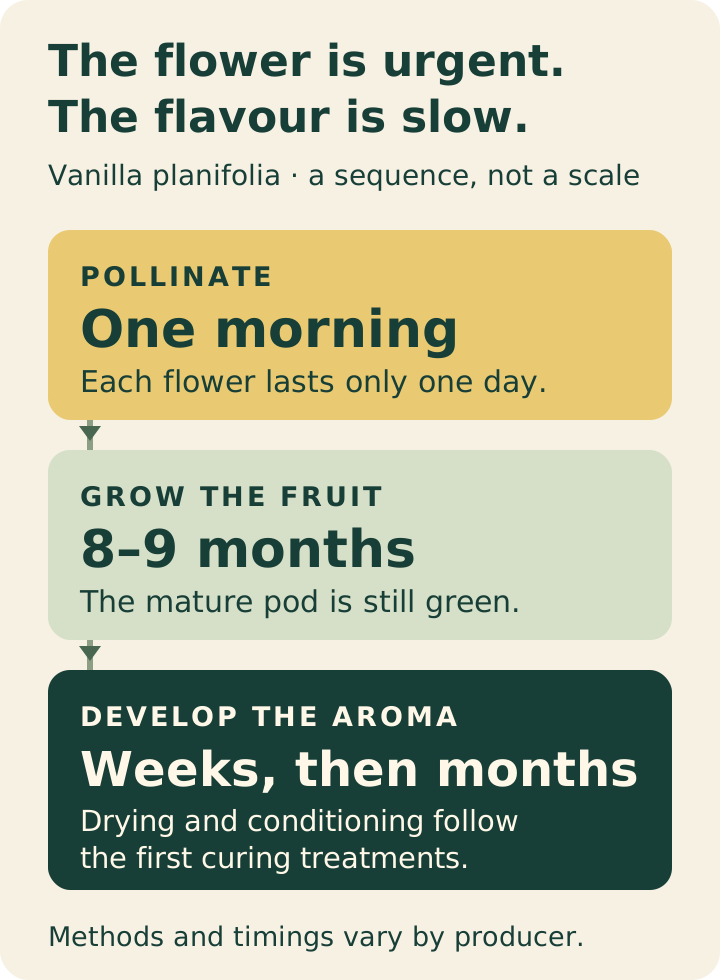
A vanilla flower opens in the morning. A grower can postpone fixing a fence or moving a ladder. This flower is a different kind of appointment: each flower of Vanilla planifolia, the main commercial vanilla species, lasts only one day.
The work is delicate and quick. The result is slow. After successful pollination, the plant needs months to grow the long fruit we call a vanilla bean. Even then, the familiar dark, fragrant ingredient is still several stages away.
So a pod of vanilla contains a curious pair of timescales: a window you must not miss, followed by a wait you cannot skip. Between them stands a tiny flap of tissue—and a person who knows how to move it.
Both parts are there. They cannot meet.
Vanilla is a climbing orchid. Inside one flower are both the pollen and the surface that needs to receive it, the stigma. But a flap called the rostellum separates them. Having everything in the same flower does not mean it will pollinate itself.
A worker uses a slender implement to lift the flap, then brings the pollen-bearing part into contact with the stigma. The gesture bypasses a physical barrier; it does not add a missing ingredient. The University of Florida's grower guide recommends doing this in the morning, usually between six and noon.
Flowers on a vine open in succession during the flowering season. There is another round to inspect tomorrow, but it will not rescue the flower missed today. This is why a short hand movement becomes a repeated commitment to being there.
Commercial production relies heavily on this work, including in vanilla's native region. Natural fruit-setting is too unreliable to build a commercial harvest around. The often-repeated explanation that one particular bee performs the job everywhere in Mexico is more confident than the evidence: researchers still debate the natural pollinators of V. planifolia.
The child whose gesture travelled
One name belongs beside that movement: Edmond Albius. In 1841, on Réunion in the Indian Ocean, he was an enslaved boy of twelve. He developed an effective way to pollinate vanilla by hand, a practical contribution that helped transform production on the island.
It is tempting to tell this as a locked door that nobody had opened before a child found the key. The historical record is less tidy. Charles Morren had already achieved artificial pollination in Liège in 1836. Albius's importance does not depend on pretending otherwise: making a method work in cultivation, and helping it spread, mattered enormously.
A 2024 historical review distinguishes his crucial practical role from the claim that he was the sole inventor of artificial vanilla pollination. The Smithsonian's account adds a harder detail: although his innovation received recognition, he was not compensated for it.
Hold those two thoughts together. Credit can be precise without becoming small. And a discovery can enrich an industry without enriching the person responsible for it.
Success looks disappointingly green
Once pollination succeeds, the ovary develops into an elongated fruit. The Florida guide gives roughly eight to nine months for ripening. The object called a bean is botanically a capsule, containing thousands of tiny seeds.
If you picture a dark, wrinkled pod growing on the vine, replace that picture. The fresh fruit is green. The French National Museum of Natural History describes fresh pods as odourless. Harvesting a mature fruit is not the same as finishing the spice.
That is the second surprise. The grower has met the deadline and waited through the growing season—and the aroma still needs another transformation.
The smell is made after the harvest
Curing changes the fruit chemically as well as physically. Among its important changes is the conversion of glucovanillin, a compound accumulated in the green capsule, into vanillin, a major contributor to vanilla's recognisable aroma.
Methods vary, but the sequence includes a heat treatment, a warm humid stage often called sweating, drying, and conditioning. These are separate jobs, not one instruction to leave the fruit in the sun. The University of Florida's processing guide describes drying that can take weeks and conditioning that can take months.
The first clock demanded speed. This one demands patience. A green pod and a cured pod are the same fruit at very different points in its life as an ingredient.
Look at a pod as a record
Next time you have a whole vanilla pod to hand, pause before using it. Its long shape is the shape of a fruit. The tiny seeds inside are another clue that this came from a flower. Its dark, flexible body records processing after harvest; that colour was not what the grower saw on the vine.
You can follow the same story into a bottle: natural vanilla extract is made by extracting compounds from cured vanilla in an alcohol-and-water mixture. The bottle begins after the flower, the fruit and the curing work—not instead of them.
None of this requires you to buy a special ingredient. It offers a different way to notice one you may already use. The next familiar vanilla smell has a less familiar beginning: a flower open for a day, a hand at the right time, and a long sequence of people waiting, checking and working.
Plain is a small word for that much attention.