Saffron: why a tiny jar starts with so many flowers
To understand saffron, start with one flower and count to three. Two diagrams trace the path from its red stigma branches to the dried spice.
A jar that seems too small
Picture a spice shelf: pepper, cumin, oregano. Among the containers sits a jar of saffron small enough to almost disappear in the palm of your hand. Inside are a few red threads. If you try to understand its value by looking only at the space it takes up, part of the story is missing.
To find it, follow the journey backwards. Leave the jar, mentally undo the drying and return each thread to its flower. There you find the decisive detail: only a tiny portion is taken from a large, showy bloom.
The flower offers three
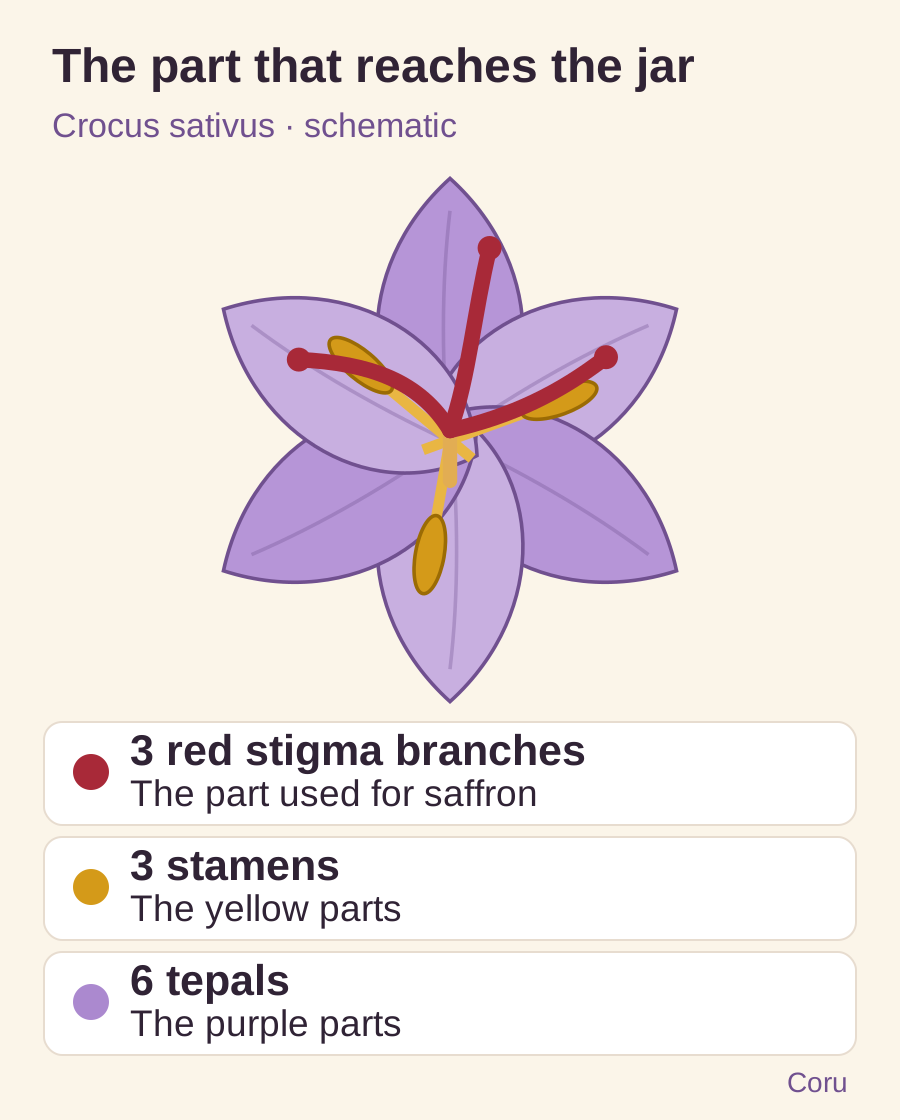
Saffron comes from Crocus sativus. Its flower has six purple, petal-like parts called tepals, and three stamens. At the centre, a structure called the style divides into three stigma-bearing branches: these red branches are the parts harvested to make the spice. The botanical description from Naturalis distinguishes these structures clearly; the yellow and purple parts are not the saffron threads.
In the diagram, follow the three red branches back to where they join. The flower looks generous, yet the harvest that matters fits into three lines. That change of scale explains more than a picture of the jar: the showy bloom and the portion used as a spice take up very different amounts of space.
Now repeat the gesture
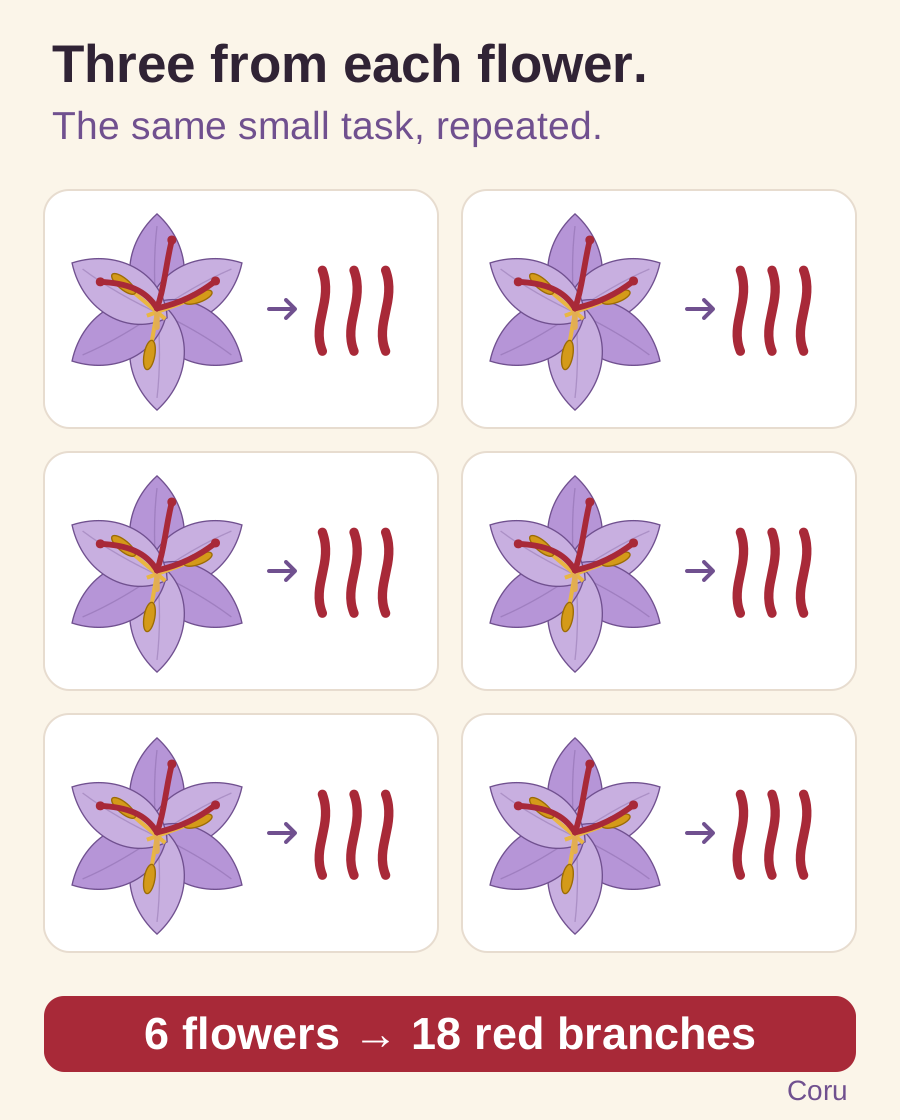
One flower provides three branches; six flowers provide eighteen. This counts parts, not grams. Repeating the drawing reveals what the packaging hides: gathering lots of threads means working through lots of flowers.
For a sense of scale, a University of Vermont factsheet from 2020 estimates approximately 167 flowers to produce one gram of dried saffron. The source itself notes that the result depends on the weight of the stigmas, which varies with their length and density. This is not an exact conversion for every harvest.
So you cannot work out how many flowers went into a jar by counting its fragments. The figure helps you imagine the accumulated work; it does not reconstruct the exact life story of a packaged spice.
Harvesting continues after picking
Picking the flowers does not finish the job. Vermont’s harvesting guide describes separating the stigmas from the tepals and stamens. In the usual method it presents, the flowers are brought indoors for this separation by hand.
Freshly picked flowers cannot wait around like plastic parts, either. The guide recommends processing them promptly: as they go limp or wilt, separating their parts becomes harder. Two rhythms have to work together: gathering the blooms and attending to those tiny branches, flower by flower.
This is the shift in perspective. In the jar, you see a quantity. Before the jar, there was a sequence of gestures. Their repetition and delicacy help explain why producing this spice takes so much work.
There is still the drying
The fresh red branches are not yet the dried threads on the shelf. Drying removes water. And the process matters for more than weight: Vermont’s research explains that handling after harvest, including drying, influences colour, flavour and aroma.
That journey also leaves you with a useful choice at home. The Royal Horticultural Society advises keeping dried saffron in an airtight container away from light. Where you store the jar is part of caring for an ingredient that has already been through several stages.
Return to the spice shelf. The jar is still small. What has changed is the scale of what you imagine inside it: flowers, groups of three, patient separation and water that is no longer there.