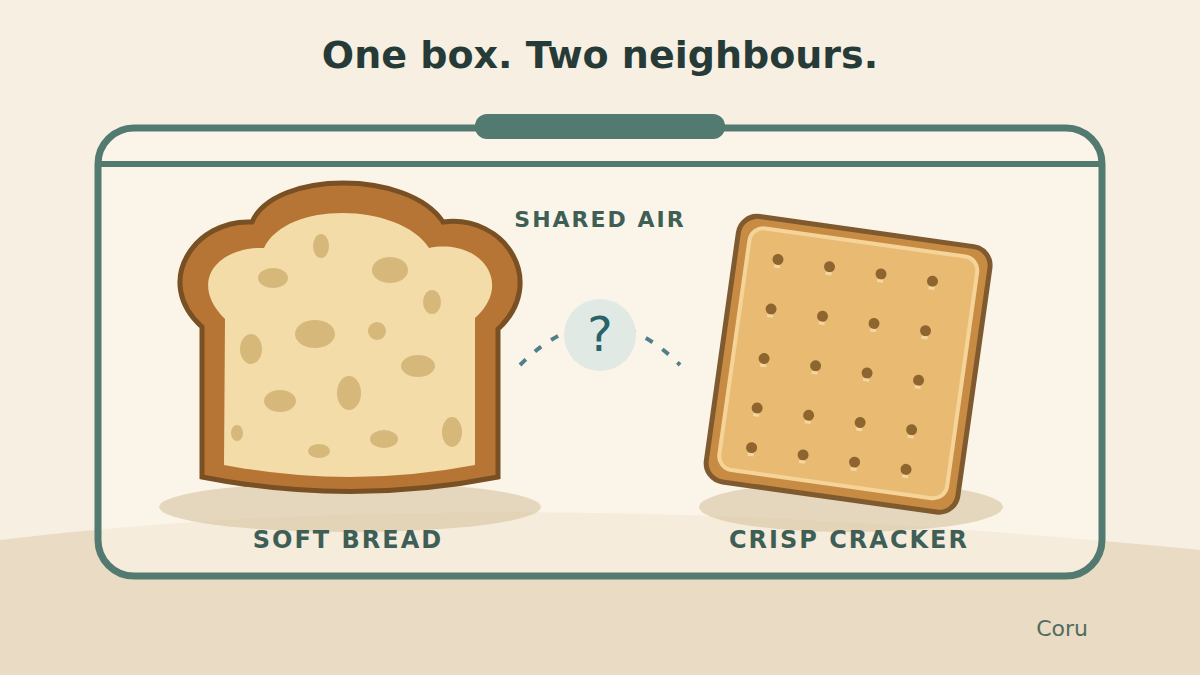
Bread and a cracker share a box. Which loses water?
There is a gap between them. The lid is shut. They can still exchange water.
Make your prediction first
Imagine a fresh slice of soft bread and a dry, crisp cracker. They share an airtight box without touching. Nobody pours any water inside. Which exchange would you expect?
Which way does the moisture move?
Choose an answer, then open its explanation below.
Answers and explanations
- The cracker gains moisture from the bread: Yes: for this pair, expect moisture to move from fresh bread to the dry cracker through the shared air.
- The bread gains moisture from the cracker: For this pair, expect the opposite: fresh bread supplies moisture to the dry cracker.
- Nothing moves unless they touch: Water vapour travels through the shared air. The foods do not need to touch.
The lid does not separate the neighbours
For this pair, expect moisture to move from the bread to the cracker. Water can enter the air inside the box and then be taken up by the dry food. The surfaces need not touch. An airtight lid limits exchange with the room; it still leaves the foods sharing the air inside.
That is the idea behind a familiar baking trick: put a slice of bread in a sealed container with cookies you want to keep soft. The King Arthur Baking team describes it. But a cracker usually has the opposite job. As it takes up moisture, it can lose its crispness. What helps one texture can spoil another.
Who gets to keep the water?
“The wetter one gives water to the drier one” is a useful guess for this scene, but a poor universal rule. Sugars, salts and the structure of the food affect how its water behaves. Moisture content and water activity describe different things.
Water activity describes the availability of water in a food; it is determined through the equilibrium humidity of the air above a sample at a given temperature. At the same temperature, moisture moves from higher to lower water activity. Percentages of water alone cannot tell you the direction for every possible pair of foods.
Fresh soft bread beside an ordinary dry cracker gives us a clear direction. The speed, degree of softening and final texture still depend on the recipe, size, temperature and packaging. There is no stopwatch in our drawing: it explains a mechanism, not a guaranteed result by breakfast.
Now remove the cracker
Only the bread remains. Better still, imagine a controlled laboratory experiment: the total moisture content of the crumb is held constant. Must it now stay soft forever?
Does constant moisture content guarantee soft crumb?
Choose an answer, then open its explanation below.
Answers and explanations
- No: the crumb structure also changes: Right. Constant total moisture content does not freeze the structure of bread.
- Yes: without water loss, it cannot stale: Holding the total moisture content constant is not enough: the crumb structure keeps changing.
Answers and explanations
- No: the crumb structure also changes: Right. Constant total moisture content does not freeze the structure of bread.
- Yes: without water loss, it cannot stale: Holding the total moisture content constant is not enough: the crumb structure keeps changing.
Bread has another way to become firmer
No. In a 1997 study, Giovanelli, Peri and Borri stored crumb samples at 20 °C and constant moisture content. They still measured firming and changes in the starch. Staling does not require all the lost softness to have escaped from the loaf along with water.
After baking, starch gradually reorganises: its chains can form more ordered regions again. This process is called retrogradation. Water remains part of the story, redistributing between components and regions within the bread.
Even “retrogradation” is not a complete explanation on its own. In a 2003 study by Baik and colleagues, adding glycerol slowed retrogradation but made firming faster. The authors identified other contributions, including local dehydration of the structure and stiffening of the protein network. That is a test of an oversimple explanation, not a recipe involving glycerol.
Return to the two neighbours
One box can leave the bread less soft and the cracker less crisp. They share the air, but each has a different desirable state.
Now mentally replace the cracker with a soft cookie. The same moisture transfer may be welcome. The physics has not changed; the texture you wanted has.
A lid can separate food from the room. It never promised to stop everything happening inside the food.
Sources & further reading
- King Arthur Baking — How can I keep cookies soft?
- American Society of Baking — Water
- CSIRO / USDA ARS — Water Activity in Food
- Giovanelli, Peri & Borri (1997) — Effects of Baking Temperature on Crumb-Staling Kinetics
- Baik, Dickinson & Chinachoti (2003) — Solid-State 13C CP/MAS NMR studies on aging of starch in white bread
- METER — Fundamentals of Water Activity, pp.6 and9